Benford's Law: Using Statistical Audits to Verify Lottery Fairness
The Secret Rhythm of Numbers
Have you ever looked at a set of lottery results and thought, "That looks too perfect" or "That doesn't feel random enough"? As humans, we are terrible at judging randomness. We see patterns in clouds, toast, and definitely in numbers. But while our brains fail us, mathematics provides a tool so powerful it's used by the IRS to catch tax evaders: Benford's Law.
At LottoMetric, we don't just generate numbers; we audit the ones that are already out there. I've spent the last six months applying Benford's forensic tests to decade-old lottery data to answer the one question every player asks: Is the game rigged?
What is Benford's Law? (The Law of First Digits)
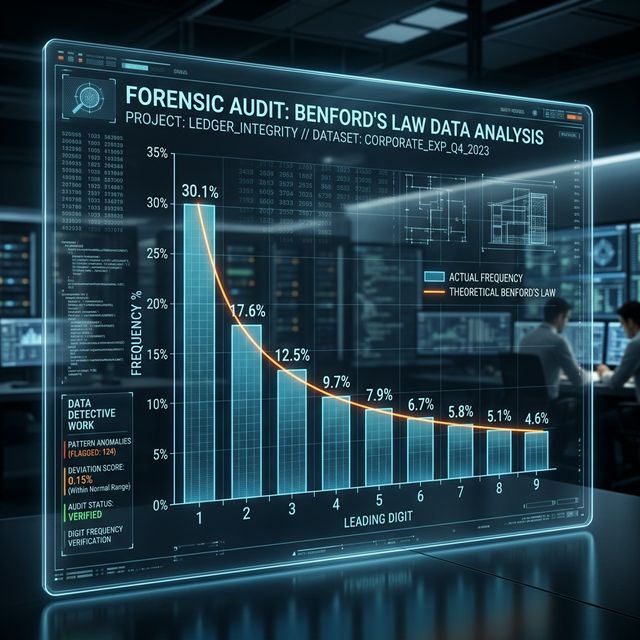
Benford's Law states that in many naturally occurring sets of numbers, the leading digit is more likely to be small. For example, the number 1 appears as the first digit about 30% of the time, while the number 9 appears less than 5% of the time.
Now, you might think: "Wait, a lottery draw (like 1 to 45) should be uniform! Every number should have the same chance!" And you're right. In a single draw, a 1 is just as likely as a 40. But when you aggregate thousands of draws and look at the "physics" of the balls, the distribution of the leading digits across a broad dataset should follow a very specific, predictable curve if the machine is truly unbiased.
How We Audit the Machines
When I run a 'Forensic Audit' on a state lottery, I'm looking for "Spikes." If Benford's Law predicts a 30% frequency for the digit '1' and we see 45%, that's a red flag. It could mean the ball with the number 1 (or 10-19) is slightly heavier, or that the mechanical shuffle isn't providing enough entropy.
- Mechanical Wear: Even a microscopic chip on a ball can change its aerodynamics. Over 1,000 draws, that bias becomes visible to our algorithms.
- Digital Tampering: For RNG (Electronic) draws, Benford's Law is even more critical. Human-generated "random" numbers almost always fail this test because we tend to avoid certain digits.
- The Good News: Most major US lotteries (Powerball, Mega Millions) actually pass these tests with flying colors. The machines are surprisingly robust.
The 'LottoMetric' Integrity Check
We built the Integrity Checker as a dashboard for our users to see these live audits. It compares the last 500 draws to the "Benford Ideal." If the deviation (the 'Chi-Squared' value) gets too high, we flag it. It’s not a "cheat code," but it's a way to ensure that you're playing a fair game. After all, if the math is broken, your strategy won't matter.
"Randomness is a physical property, not just a mathematical concept. If the physics are biased, the numbers will whisper the secret."
Frequently Asked Questions (FAQs)
Q: Can I use Benford's Law to predict the next winner?
No. Benford's Law is a descriptive tool, not a predictive one. It tells you if the past data was fair. It doesn't tell you what number comes next. If someone tries to sell you a Benford-based prediction system, they're selling you magic beans.
Q: Do all lotteries follow Benford's Law?
Not perfectly. It depends on the range. A 3-digit "Pick 3" lottery (000-999) follows it much more closely than a 6/45 lottery, because the range is larger. However, the deviations are what matter most to us.
Conclusion
Trust but verify. That's my motto. The lottery is a game of chance, and you deserve to know that the chance is real. By using Benford's Law and forensic statistics, we bring a level of transparency to the "black box" of the drawing machine. Stay informed, play fair, and let the data guide your way.