Avoiding the Herd: The Psychology of Number Selection Clusters
The 'Invisible' Strategy of Crowds
Here’s a paradox: Every combination of numbers has the exact same chance of being drawn. (We've said this a thousand times, and it's still true.) However, not every combination is worth the same amount of money.
If you pick the numbers 1, 2, 3, 4, 5, and 6, and they actually hit, you're going to be a millionaire, right? Wrong. You'll likely end up with about $5,000 because ten thousand other people picked that exact same "clever" sequence. At LottoMetric, we call this The Herd Trap. To truly play for a life-changing win, you have to understand the psychology of the people standing in line next to you.
The Birthday Trap: Numbers 1-31
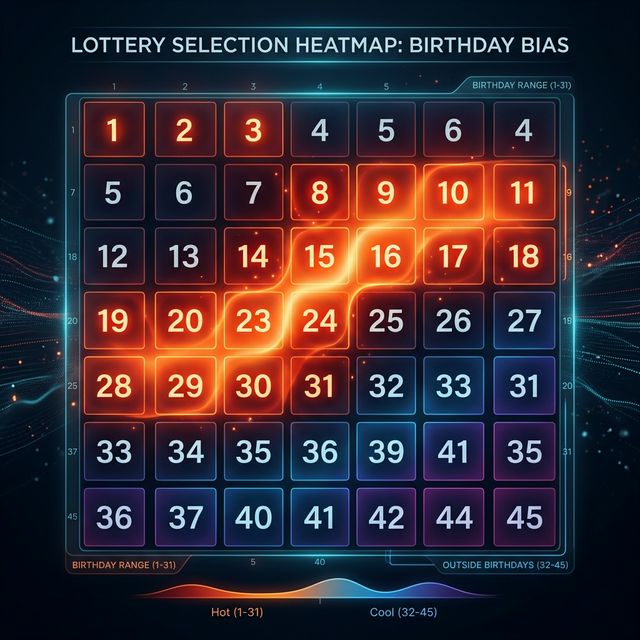
Most people pick numbers based on emotion. They use birthdays of children, anniversaries, or "lucky" days. This creates a massive statistical bias toward the numbers 1 through 31.
When we analyzed the "Public Heatmap" for a typical Powerball drawing, the difference was staggering. The numbers 7, 11, and 23 are often played three times more often than numbers like 38 or 44. If you win with a birthday-heavy ticket, get ready to split your jackpot with dozens of others who were also born in '74 or '88.
Visual Patterns: The 'X' and the 'Straight Line'
Another psychological quirk is our love for geometry. Thousands of people fill out their lottery slips in straight vertical lines, horizontal rows, or even making an "X" pattern across the grid.
It feels "random" to the person doing it, but it’s a predictable human behavior. If a drawing ever came up as a perfect diagonal on the slip, there would be thousands of winners. In 2026, where digital slips are common, we still see people clicking 1-11-21-31-41 because it "looks even." Avoid the aesthetics; the universe doesn't care about your grid alignment.
The 'Loneliest' Numbers: Our Strategy
Our Bias-Free Generator is designed with one goal in mind: Entropy. It purposefully pushes you away from common clusters. We prioritize what we call "lonely numbers"—the ones that are statistically neglected by the public.
- Go High: Focus on the range above 31. There are no months with 40 days.
- Random is Ugly: Truly random numbers look messy. They cluster in weird ways and leave huge gaps. If your ticket looks "balanced," it's probably biased by your brain.
- The Payout Edge: By picking unpopular numbers, you don't increase your odds of winning, but you vastly increase your solo prize expectancy.
Frequently Asked Questions (FAQs)
Q: If I pick 'unpopular' numbers, aren't they less likely to be drawn?
Absolutely not. The machine doesn't know which numbers were played. Every number (1 through 45) is a physical ball with the same weight. The machine is blind to your "lonely" strategy—and that's exactly why it works.
Q: What's the most 'ignored' number?
Statistically, number 41 and 43 are often among the least played. They don't have a "lucky" reputation, they aren't birthdays, and they aren't at the "corners" of the slip. They are the definition of forgotten.
The Bottom Line
Don't be part of the herd. If you’re going to spend your hard-earned money on a dream, make sure you don’t have to share it with five thousand strangers. Move your picks to the statistical edges, embrace the high numbers, and play for the whole prize, not just a slice.