Inflation vs. Annuity: The Hidden Cost of the 30-Year Payout
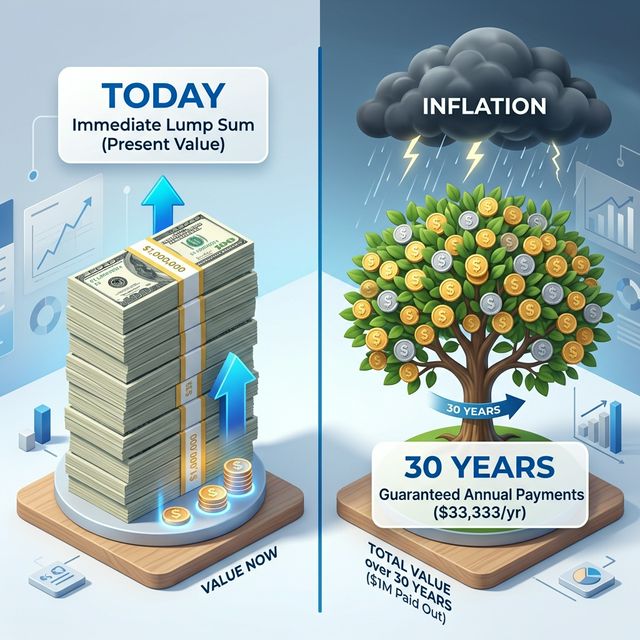
The Billion Dollar Question: Cash or Check?
Imagine the moment: You’ve just scanned your ticket, and the screen flashes "JACKPOT WINNER." After the screaming stops and the adrenaline fades, you have to make the most important financial decision of your life. Do you take the "Cash Option" (a smaller lump sum today) or the "Annuity" (30 payments over 29 years)?
In the past, the advice was simple: "Take the cash, invest it, and you'll beat the annuity." But in 2026, with shifting interest rates and a volatile global economy, the math has become far more complex. Today, I'm going to break down the Net Present Value (NPV) of your win and show you why the annuity might actually be a 'hidden' winner.
The Annuity's Secret Weapon: The 5% Graduation
Most players don't realize that the Powerball/Mega Millions annuity isn't 30 equal payments. It’s a "graduated" annuity that increases by 5% every single year. This is designed to help your prize keep pace with the cost of living.
For example, if your first payment is $1,000,000, your final payment 30 years from now will be approximately $4,116,000. That’s a massive jump. The question is: will $4.1 million in the year 2056 buy more or less than $1 million today? That's where Inflation comes into the picture.
The Time Value of Money (TVM)
In finance, a dollar today is worth more than a dollar tomorrow. Why? Because you can invest that dollar today and earn interest. When you take the Cash Option, you are essentially "buying out" the future payments at a discount rate set by the lottery commission (based on US Treasury rates).
- Low Interest Environment: When rates are low, the Cash Option is huge (close to the Jackpot total).
- High Interest Environment (2026): When rates are high, the Cash Option looks much smaller (often only 45-50% of the total). This makes the annuity look more attractive.
- The Inflation Hedge: If inflation stays above 3% for the next three decades, even a 5% increase in your payout might feel like you're just treading water.
A Behavioral Perspective: The 'Winner's Curse'
Setting the math aside, we have to talk about human nature. We've all seen the tragic stories of lottery winners who go broke within five years. Taking the cash is a massive responsibility. You are suddenly managing a hedge-fund-sized portfolio.
The annuity acts as a forced discipline mechanism. It's an "un-ruinable" salary. Even if you make a terrible investment in year 1, a fresh million-dollar check arrives in year 2. For many people, the peace of mind provided by the annuity is worth more than the mathematical "optimal" play of taking the cash.
Frequently Asked Questions (FAQs)
Q: Can I change my mind after I pick?
In most states, no. Once you sign that claim form and select "Cash" or "Annuity," you are locked in. This is why we created the Annuity vs. Cash Calculator—run the numbers before you head to the lottery headquarters.
Q: What happens to the annuity if I pass away?
This is a common myth—the lottery does not keep the money. The remaining payments become part of your estate and go to your heirs. They can even choose to liquidate the remaining payments into a lump sum for the estate taxes if needed.
The Bottom Line
The decision between cash and annuity isn't just about math; it's about your personal Risk Profile. If you are a disciplined investor who understands the 2026 markets, take the cash. If you want a guaranteed, inflation-adjusted lifestyle that you can't accidentally spend in a weekend, the annuity is a world-class financial product. Use our tools, talk to a fiduciary, and choose the path that lets you sleep at night.